

The Circuit
An Alternative Distribution Roadmap and Network for NonDē Filmmakers


Letter from the Editor:
I want to start off by saying, I wish things were different right now.
I wish the world was different.
Specifically in the film industry, I wish the systems in place weren’t broken and exploitative or at the very least, just trying to hold on for dear life.
Because that means we wouldn’t have to be doing what we’re doing right now.
That means we could just make our movies and that would be enough.
They would be marketed and distributed properly and reach the audiences they were meant to reach and we’d all have long, fruitful careers and everything would be in its proper place working together to circulate and elevate this cinematic artform we all love so dearly and we’d be making movies that excite and expand our worlds rather than contort themselves inside pre-determined metrics and suffocating idealogies.
This is not the reality we live in right now.
Not only has truly “ambitiously-authored cinema” become more fragmented and disenfranchised to the point of disappearing entirely after a festival run (if it even has one) but the work itself has become all the more difficult to get made. For people to see the value in it.
It’s an uphill battle that does not let up even in post.
In fact, some would say after the film is made is when the real battle begins.
We all know that distribution is where your film can and will likely go to die. - Jennifer Esposito
Now come on, how long have you known me?
You think I’d bring all this doom and gloom your way if I didn’t have at least an inkling of an idea on how to solve it?
Before we get into the vision behind an alternative distribution path/network I’ve dubbed The Circuit, I’d like to offer you some quick thoughts I’ve had over the past week that I think will help put both The Label’s future and yours into a clearer perspective.
The Label Newsletter not only seeks to bring you “the latest conversations surrounding the future of cinema and the people advancing the culture of film,” but it is also focused on finding the gaps in the industry and the ways in which to fill those gaps as stated in the latest post, The Pivot:
One of the greatest benefits in getting to discuss how to start a business with someone is the problem-solving in real time that happens organically in conversation. For months Ellis and I discussed all the areas in which cinema’s ecosystem can be improved upon and as you would guess - there are a lot of them. In fact the whole industry just about needs to be reimagined from scratch - which it currently is - and in fact a good chunk of that reimagining is happening on this platform. But these major shortcomings are exactly why I think the future of cinema belongs not only to those filmmakers who expand upon the art of cinema, but those who also help fill in its current gaps.
It occurred to me this past week, that one of the gaps may also be in the language surrounding this concept of NonDē or non-dependent filmmaking.
Now NonDē has become sort of a blanket term for many things this past year as there are many things we need in our industry right now that center around this ethos of championing the art, the artist, and the audience.
In its current form, NonDē is:
A movement gaining momentum through the ND50 initiative led by Courtney Romano.
An ecosystem that has been slowly spelled out by Ted Hope for the past three years and is now actively being built and championed by the members of the film community here on Substack and through partnerships with those off of the platform such as Keith Ochwat at Show & Tell.
Again, an ideology, that believes in the necessary centering of the art, the artist, and the audience that the becomes the foundation for building the future of cinema.
And to many, it is a declaration to not wait for permission but to make movies now with micro-budgets and a scrappy, punk rock attitude.
In thinking about all of the ways NonDē lives in the world today - or at the very least on this platform - for me, what NonDē is at its core and what I think all of these iterations of it are more or less “getting at” is:
It is a wake-up call that gives people an opportunity to meet the moment we all find ourselves in head-on.
More specifically, it is not a call to alarm people or to make them feel powerless or hopeless, but quite the opposite - it is a call to equip us with the education, information, resources, and community necessary to figure out for ourselves how to be a filmmaker right now. And its collective power and collaborative nature gives us all a fighting chance for a future in this seemingly “dying industry.”
Now, whether you think Hollywood and the old studio systems are dead or not is not really the point. Whether you vow to never work with them again or still hope to posture your career as valuable to them so that want to work with you in the future is not the point. The point is that regardless of your feelings for old systems and ways of doing and thinking -
it is undeniable that everything that once worked isn’t working anymore the way it used to.
Streaming changed everything.
The creator economy changed everything.
Monopolization changed everything.
Our addiction to social media and digital content changed everything.
Media consolidation changed everything.
And if it has its way, AI will change everything.
But it’s not that movies (or the “product” in which our industry thrives) are suddenly dead or no longer relevant, it’s that the old ways in which we used to measure their success and impact are no longer adequate or helpful and we haven’t fully found or embraced a new way to talk about this artform and its inherent value.
We still talk about “box office numbers” like it has any impact on the current conversation of independent or non-dependent filmmaking right now. We still talk about the Oscars like it didn’t just become the spectacle it needed to be to stay “in business.”
This isn’t condemnation, this is recognizing that the moment we are in right now requires not just new entrepreneurial pursuits from companies like Kinema or Gathr who are figuring out what it means to have a filmmaker-first platform with direct connection to audience. And it doesn’t just require for us as filmmakers to study things like marketing and distribution; not because we want “jobs” in that line of work, but because that kind of information is necessary for our life’s work at this moment - for our films, for our career, for our livelihoods. And it doesn’t just require new ways of talking, discussing, and conversing about films, filmmakers, and filmmaking.
It requires all these things to be working together to build the kind of future for film where we not only have a “fighting chance,” but one in which the art, the artist, and the audience thrive.
And I would also like to say all this work becomes lighter the more people with clear visions and sharp ideas get involved and the more we partner up with other platforms and businesses actively building new paths, because especially right now:
This is about creating the infrastructure that leads us to a future.
One where you can decide which path you’d like to take because all the ways are clear.
And yeah, it’s A LOT of work and its grueling and it goes largely unseen right now, but if we do not put in this kind of effort now, this movement, this ecosystem, this idealogy, and this declaration we are all so currently adamant about will not be anything more than enriching conversations we had that one time on that one platform.
Which leads me to The Circuit.
It’s clear that one of the “biggest problems” in the industry right now is distribution.
To very briefly sum up what distribution is,
it is that crucial link between “your film” and “the audience” who will watch it.
And I couldn’t sum up the reason behind The Circuit better or more succinctly than this note exchange between Jennifer Esposito and Cameron S. Mitchell and an excerpt from Ellis J. Sutton’s latest post:
What Else Do Theaters Need for a Comeback?
If playing only old hits has a shelf life, what’s needed to continue regaining and growing the theater-going audience? Industry observers suggest a multi pronged path forward, with nostalgia being just one element:
A Strong Slate of New Films:
Ultimately, nothing boosts theaters like must-see new content.
- Ellis J. Sutton, Can Revival Houses “revive” Cinema?
The Vision behind The Circuit:
Now as I said before, largely what is needed right now is new infrastructure to fit our current times.
This is not a sexy line of work to be in - I know.
But infrastructure builds cohesion and momentum and creates a stable foundation in which to build and expand upon. Which makes it a required step in this future-building process.
And right now, the distribution of not simply art-house cinema, indie flicks, or what we’re now calling NonDē films is entirely broken and un-necessarily convoluted, but the distribution of Hollywood “hits” in which they pour millions upon millions of dollars into is too - yet they keep making them.
That is such a wild concept to me.
It’s like you’re truly pouring water, or in this obvious case money, into a bucket with an unbelievably large hole, praying that the bottom doesn’t fall out.
Just stop pouring millions (on sequels and franchises) into a broken bucket and fix it.
I get it, things like bottom lines, valuations, egos, LLCs, tech, wall street, greed, did I mention egos, get in the way.
So instead of simply riling everyone up to make these great, ambitiously-authored cinematic experiences, only to say good luck once they get to the point they can start pouring into the bucket.
Why don’t we just make our own bucket?
Okay I’m done with this metaphor, because The Circuit is more like a highway anyway and it’s really not meant to replace anything. It’s meant to do what NonDē does best and equip filmmakers with a clear, path forward once your film is made and it is totally up to you whether you take this path or not.
There were two gaps in which I’ve been trying to find a solution for that I think The Circuit solves:
How do you get “audiences” excited about cinema from unknown or first-time filmmakers.
How do you create a clear distribution path for filmmakers who may want to avoid “traditional
exploitativeroutes.”
The solution seemed easy enough -
by putting the exhibitors, filmmakers, and audiences in direct contact with one another.
What better way to get people excited about going to see movies than to show other people seeing movies and talking about them. i.e. than to build a community that connects audiences with their next favorite filmmaker and exhibitors with ambitiously-authored work.
Now ultimately the goal is to create an app that acts as not only a “social media platform” where you can post pictures and join in live conversations with others around the world who are watching the same movie as you - we’re talking global streaming events, ya’ll. It would also acts as a (transparent!) data collection tool so that exhibitors and filmmakers can make smarter decisions on things like: which cities and films go best together, if you wanted to take your film on tour - what are some cities it might do well in, which films are resonated with audiences that might then get picked up by a larger platform (if the filmmaker chooses), etc… and audiences can find in-person events near them and in any city they might be visiting where they know they’ll get to experience movies they might not find anywhere else - remember the above note exchange about film festivals and how so many great films are just getting left on the table right now??
Practically, as we ( jake S. weisman, Avi Setton, and I - along with a growing list of others) build up to the app and a global streaming event these are the working parts we have going on that you can be involved in already…
A GLOBAL LIST OF EXHIBITORS:
If there was a road map already in place of the theaters to reach out to to screen my movie, I’d be in my car tomorrow. - Tom Violett
I had a wonderful conversation with Tom Violett and Michael Lavine where they both expressed how fruitful connecting with their local theater scene has already been for them and neither one of the have their features finished yet.
Now imagine how fruitful it could be for you? And how easy it would be to start reaching out to your local or state-wide theaters to foster a connection and then to add it to this immensely incredible resource we’re building here and can provide filmmakers with a “roadmap” in which to connect with exhibitors around the world.
Hey Filmstackers! Imagine you’ve finally finished your NonDē film and you’re ready to go out on the road and show your movie to the world. Where do you begin?
We NEED a list of the best independent movie theaters, cultural institutions, micro cinemas and anywhere else where we can screen our films all across the country. Inspired by Ted Hope and the push to create a more sustainable distribution model Taylor Lewis, Su Tais and I have created a form to build an Alternate Venue Database to assist filmmakers with their self-distribution releases. But we need your help to grow the list. - Michael Lavine

ROADSHOWS, OR WHY YOU SHOULD TAKE YOUR FILM ON TOUR:
Hollywood would have you believe you’re competing with Wicked. We rarely stop to think about how fucking wild that is. I insist to repeat: that’s like my band Jacob Poppins & The Chimney Sweeps - with a tightly recorded LP and a few live shows under our belt – comparing ourselves to Taylor Swift. To continue the metaphor: are we, the indie musicmakers, to continually compete in randomly sponsored “Battles of the Band” around the country? Will this get us to our desired Swift level? Then why should a film festival work for my flick?
Different levels. Different venues. Different communities. Different networks. Dig this: you make a movie and premiere it in a 30 seat theater for $whatever in Burlington, Vermont. Word of mouth is surprisingly strong for your flick! Congratulations. More and more folks buy tickets. Now you’re selling out this 30 seat show after show, night after night. Maybe it might be worth looking into an 80 seat theater, move shop to a bigger house. Maybe you up ticket prices. (Not for nothin’ but now’s the time to start thinkin’ about merch. Jus’ sayin’.) But it actually gets more exciting…
We’ll have learned from experience which audiences around the country play like the Burlington, Vermont audience. Our micro owners in Portland, Oregon and Charleston, West Virginia have heard about the success of your flick in B-town and want to try it in their own 30 seat theaters. All of the sudden, your movie is selling out three whole communities nationally– and word is getting ‘round! Nashville, Orlando, and Philadelphia want to screen your flick in their 30 seat houses.
With this continued momentum, it’s time to choose your own adventure! What do you want for your film and your career? Keep taking your film to 30 seat theaters around the world to share with our friends in the UK, India, and South Korea? Try to build your venue size like a professional comedian? Start playing 100 seat shows and 500 seat shows? Maybe the goal is a Championship Run in DTLA’s Theater District! You’ve earned the exclusivity to show your film in a 2,000 movie palace with an eager audience. Play Carnegie Hall! Who’s gonna stop you?
- jake S. weisman, Terraforming Hollywood: Changing the Landscape of Cinema
“THIRD SPACE” CINEMA, OR FILMMAKERS TAKING DISTRIBUTION INTO THEIR OWN HANDS:
it’s easily monetized for filmmakers and can be free for audiences
Every night in hundreds of cities, hundreds of bars pay someone to host an event. They don’t do this to bolster business on that particular night, but rather to create return customers and connect with the community. These return customers bring continued support to this local establishment - and by extension, their community. It’s a beautiful ecosystem.
I’m of course talking about trivia. Microcinema hosts can imitate this model. Setting up a microcinema is easier than a typical trivia setup. If trivia can pull this off in dozens of bars in every city every night of the week, microcinemas can surely pull it off in one bar in most cities one night of the week. If we band together, we may just be able to take on 1/100th of Big Trivia’s stronghold.
Once the ecosystem is thriving, venues will vie to be the city’s Wednesday night microcinema bar. The best part about this model is the screenings can be totally free. Bars don’t charge trivia participants. They make their money in food and drinks. Maybe there’s a 2-drink minimum, or eventually a $5 charge for new movies, but the point is it’s not necessary.
Let’s say the bar pays $250 for a screening (trivia hosts make $150-$500). The host could keep $100 and pay the filmmaker $150. If you add in ticket prices, 90% could go to the filmmaker, 10% to the ticket platform, and the host could earn the entire screening fee. Eventually…
venues could rate hosts, allowing them to find consistent work, upgrade their equipment, and increase their rates
audiences could rate films, helping hosts decide which films to screen
the ecosystem would organically create microcinema classics and usher in new voices while helping filmmakers launch their careers
aspiring YouTubers could dream about becoming filmmakers again
- Avi Setton, 7 reasons why I believe 2026 will be the year of microcinemas
The Circuit in Action:
jake S. weisman, Avi Setton, and I have also been tag-teaming meetings with filmmakers who want to start their own third space or microcinema scene where they live.
And for clarity’s sake:
Third Space Cinema: are pop-up screenings that take place in third spaces such as coffee shops, bars, art galleries, etc... i.e. they already have their own built-in audience or network you can tap into.
Microcinemas: are pop-up screenings that take place in a smaller single location venue where daily, weekly, or monthly screenings are a part of the venue’s “draw.” i.e. the exhibitor or host has to build the audience.
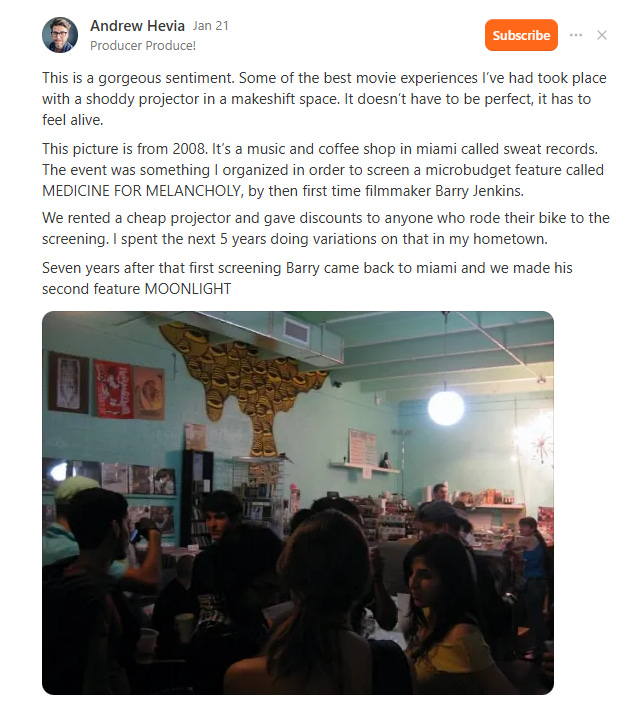
The Circuit’s Network is already turned into such a wonderful group of people who are pledging to not just share their photos with us to circulate on Substack and eventually the app which we believe will get more people excited about community-building, but to also share what they’re learning - what films are really resonating with the audience their building, what kind of conversations they’re having with them, what they’d like to see more of, you know all that valuable good old fashion data we can actually use to make smarter decisions as filmmakers and exhibitors.
The list of people and cities already on The Circuit’s “map” (and that list is only growing:)
London, England: Alex Bhat, James McLoughlin, and Daniel Harper who are currently working on their first in-person screening
Los Angeles, California: Ellis J. Sutton with Coffeehouse Cinema and jake S. weisman with the LA Film Scene
Ojai and San Luis Obispo, California: Kevin McDevitt with The Film Lab
Bombay, India: Nihaarika Negi who is a filmmaker and performance artist currently organizing a series of pop-up screenings
Margarita Island, Venezuela: Alfredo La Corte who is reaching out to a local cafe to host screenings of the films from his global production company
The goal is to start by building up local communities and scale globally through online connection.
jake S. weisman, Kevin McDevitt, and I were already talking about ways to do a trial run for a Southern California Circuit.
Like with the overall new cinematic ecosystem that’s being built, the goal for The Circuit is to have all these parts working together so that a thriving alternative distribution path can be made where a rising tide truly does lift all boats.
Not just for the hosts of these pop-up screenings in third spaces, not just the microcinemas with more permanent addresses, and not just the arthouse theaters with the latest equipment, but all these working together as they continue to create the spaces that connect the audience, the artist, the art.
If you’d like to be a part of this project, please reach out. We’d love to have you on-board.
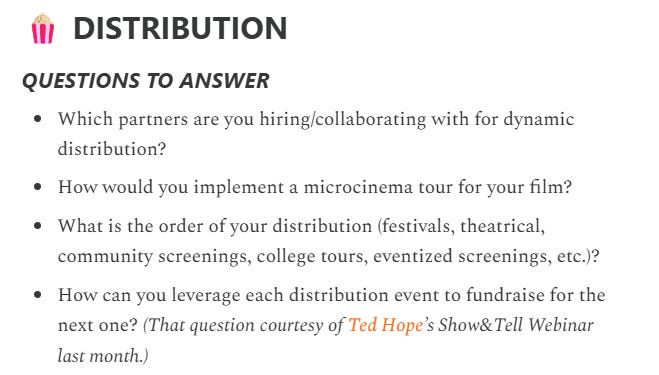
Lastly, Courtney Romano had some great questions to get you started on thinking about distribution for your own project in the most recent post on ND50 Film Project.
Cinema did not die. It just got bloated.
Bigger screens. Louder sound. Higher prices. Less intimacy. Somewhere along the way, moviegoing stopped being about gathering and started being about consumption.
Sit down. Watch. Leave.
The ritual vanished. The conversation vanished. The feeling of being part of something vanished.
And yet, people still show up.
They fill concert halls. They line up for live podcasts. They flock to pop-ups and small, intentional events.
Not because content is rare. Because connection is.
Most Americans rarely go to movie theaters anymore. Streaming made staying home easy. The casual moviegoer disappeared. But the desire to gather did not.
Cinema isn’t broken. The way we experience it is.
A microcinema is not a smaller theater. It’s a reset. A curated room where attention matters. Where the lights coming up start the experience instead of ending it.
Coffee shops are the perfect home for this. They’re already third places. Warm. Human. Familiar. Putting cinema inside them turns watching into a ritual again.
Short films belong here. They respect time. They invite conversation. They allow many voices in one night. In a microcinema, they are not appetizers. They are the point.
Streaming is convenient. It’s also isolating. Algorithms flatten taste. Shared culture erodes. In response, people are choosing phone-free, in-person experiences again.
Coffeehouse Cinema exists for that shift.
This Substack supports a growing wave of microcinemas. Spaces built for presence. For conversation. For showing up intentionally, every month.
Cinema doesn’t need bigger screens. It needs smaller rooms.
- Ellis J. Sutton, Coffeehouse Cinema
Further Reading:


 | A guest post by
|
I built this template to help cinemamakers strategize and plan out their distribution. I'd nominate it as one of my most useful posts of 2025. Give it a spin. I'd love some notes on how to improve it. https://tedhope.substack.com/p/how-do-you-best-prepare-for-your